263 Golden Hill Street · Built 1941
The building
came first.
A Colonial Revival landmark on the crest of Golden Hill. A refuge, then a stage, and now a room we intend to keep in use.
The facade
Red brick, a white portico, and a marquee
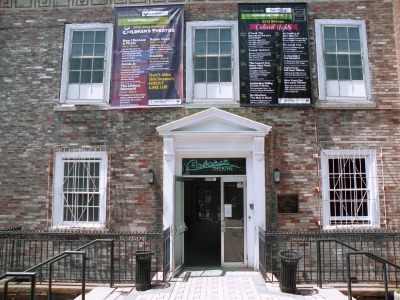
This is the only photograph of the entrance that survives in the theatre's records, taken some years ago and reproduced here at the size it exists. Season banners above the door, a classical portico, and the theatre's name in script on the glass.
We are commissioning new photography of the building. Until it is made, this is what there is, and we would rather show it plainly than blow it up.
1941
Designed to look like it had always been there
The central block at 263 Golden Hill Street was built for the Young Women's Christian Association in 1941, to designs by the architect C.W. Walker and put up by the E & F Construction Company. Rear wings followed in 1959.
Walker was working on a site that already had a history. The Albert Bishop house had stood there until 1936, and he shaped the new building in the Colonial Revival manner deliberately, so that it echoed what it replaced: red brick, a white classical portico, tall sash windows arranged in careful symmetry.
The result is a building that reads as older than it is, which was the point. It sits within what is now the Golden Hill Historic District, added to the National Register of Historic Places in 1987.
1942 to 1962
A door that stayed open
Black women in Bridgeport had founded the Phyllis Wheatley Branch of the YWCA in 1921, in answer to segregation within the original association. In 1942 the two merged here, under what the YWCA called the One YWCA Policy, and the Golden Hill building desegregated.
The organisation committed itself to working toward the elimination of racism, wherever it exists, and to serving the working women of Bridgeport regardless of race.
From 1949 the building appeared in The Negro Motorist Green Book, listed as a hotel: one of the places a Black traveller could be certain of a room. It was listed every year until 1962.
The whole span
Eighty-five years on Golden Hill
-
1936
The Bishop house comes down
The Albert Bishop residence, which had stood on the site, is demolished.
-
1941
Built for the YWCA
C.W. Walker designs the central block in the Colonial Revival manner, echoing the house it replaced. E & F Construction build it.
-
1942
Desegregated
The Bridgeport YWCA adopts the One YWCA Policy and merges with the Phyllis Wheatley Branch, founded by Black women in the city in 1921.
-
1949 to 1962
Listed in the Green Book
The building appears annually in The Negro Motorist Green Book as a hotel, offering rooms to Black travellers through Connecticut.
-
1959
Rear wings added
The building grows to the rear, roughly doubling what stands today.
-
1975
The assembly room becomes a theatre
The company that began as the Sacred Heart University Cabaret moves in under Claude McNeal, backed by civic and business leaders including Mayor Nicholas Panuzio. A balcony and air conditioning are added.
-
27 February 1976
First curtain
The theatre opens officially with Vaudeville Troupe.
-
1987
Golden Hill Historic District
The surrounding district is added to the National Register of Historic Places.
-
1995
The fly house
A $1.3 million renovation, funded by a $900,000 State grant and a capital campaign, builds a fly house over the stage and rebuilds the lighting, sound, air conditioning, lobby, house and backstage.
-
2004 to 2011
Critics Circle recognition
Connecticut Critics Circle awards and nominations, including Outstanding Production of a Musical for Sweet Charity in 2006 and the Tom Killen Award in 2004.
-
June 2026
Fifty-one years of producing ends
The resident company gives its final performance, A Chorus Line, after more than two million admissions.
-
Now
The room stays open
Under new ownership, as a venue for producers, companies, schools and crews, and for the shows we still stage ourselves.
Why we are telling you this
A room with a past is a different proposition
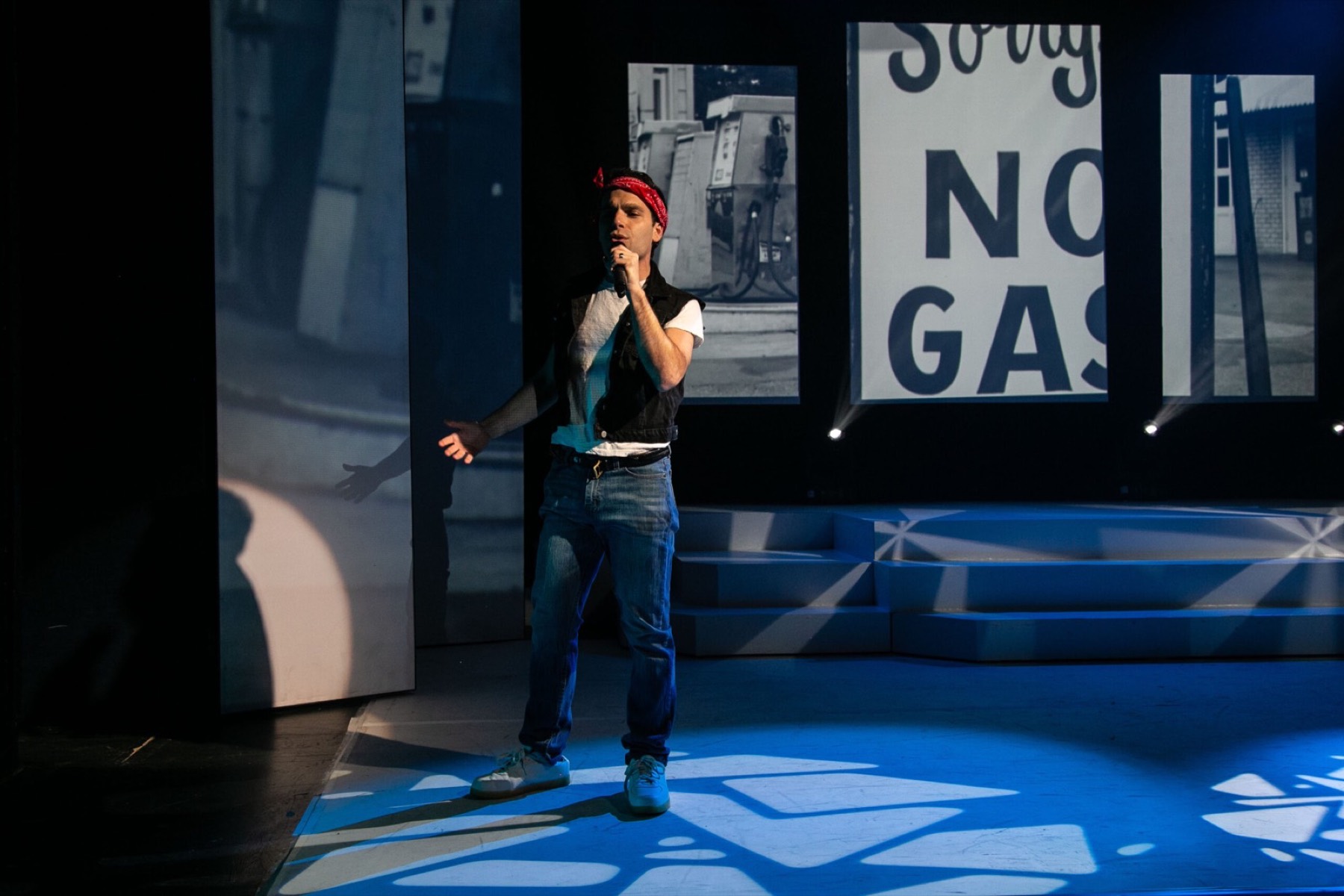
If you are choosing where to stage something, this is the part no newer venue can offer you. Five hundred productions have already worked on this floor, in a building that has been part of the city for eighty-five years.
Sources
Where this comes from
The architectural record is from Historic Buildings of Connecticut. The YWCA, Phyllis Wheatley Branch and Green Book history is from Connecticut Humanities. The theatre's own history, the 1995 renovation and the awards are from the Downtown Cabaret Theatre's records. The Golden Hill Historic District listing is from the National Register.
Planning something for this room?
Send a date range and what you have in mind.